Darllenwch y dudalen hon yn Gymraeg.
The Office for National Statistics (ONS) published its latest population estimates for Wales and England today. In our summary, it shows that the population of Wales is estimated to have decreased slightly from 2024 to 2025, by 0.1%, or by roughly 2,800 people.
Small changes in population can happen for several reasons. The latest estimates suggest that births, deaths and migration all help explain the slight decrease in the population.
This is the first decrease in the population in Wales since between 2014 and 2015. The population is estimated to have decreased slightly in 15 out of the 22 local authorities between 2024 and 2025, with the largest decrease estimated in Merthyr Tydfil, a 0.6% decrease.
These estimates are subject to statistical uncertainty, particularly for smaller areas and when looking at the data by age and by sex. Population estimates are regularly revised by the ONS to use the latest data and methods.
While the population in England is estimated to have increased overall by 0.4%, there are many areas within England that are estimated to have seen population decreases during this period, including London.
Figure 1: components of population change, 2005 to 2025 [Note 1]
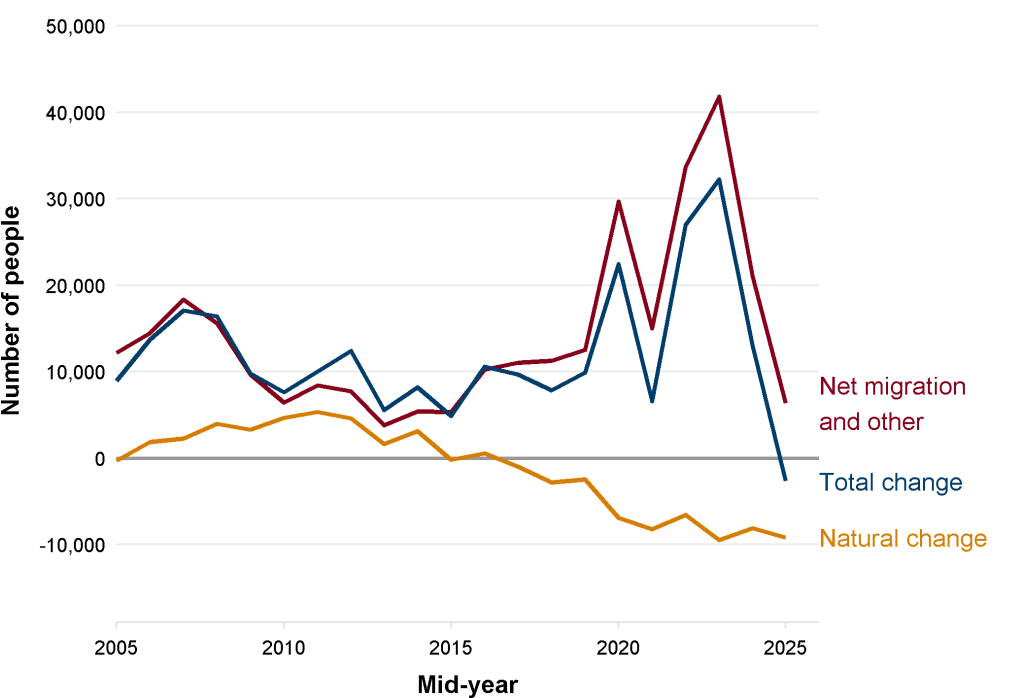
Description of figure 1: a line chart showing that migration has decreased substantially in recent years, following sharp increases. Natural change, or the difference between the number of births and deaths has also continued to decrease, leading to a small population decrease between 2024 and 2025.
Source: Population estimates from the ONS.
[Note 1] ‘Net migration and other’ includes people moving into and out of Wales, as well as changes related to armed forces personnel and other small adjustments.
In Wales, the estimated population decrease is mainly because there were fewer births than deaths, and because fewer people moved to Wales from outside the UK than in previous years. Until now, people moving to Wales had more than made up for the fact that deaths have outnumbered births. In the latest estimates, this is no longer the case.
Population changes in the future
We do not know yet whether this small population decrease will continue in the coming years. The ONS plans to publish population estimates for Wales and England for 2026 next summer. What we do know is that the number of births in 2025 showed a continued decrease (ONS), and the number of deaths is also expected to remain relatively high as larger post-war cohorts reach older ages. The latest provisional long-term international migration estimates for 2025 also show a continued decrease in net international migration for the UK (ONS).
Alongside these population estimates, both the ONS and the Welsh Government publish population projections. Projections are not predictions of exactly what will happen. They show what the population could look like if recent trends continue, using assumptions about births, deaths and migration. The ONS publishes national population projections for Wales and the other countries of the UK, and we publish population projections for local authorities and national parks.
We published our latest set of local authority projections in November last year, and these were generally based on trends up to 2022. Since then, the ONS has published its latest national population projections, which are based on trends up to 2024. This means that they take into account more recent decreases in net migration and the number of births. These suggested that Wales’s population was projected to decrease from 2036.
As a result, when we add together our current local authority population projections, the total is now higher than the latest Wales-level projection and higher than the latest population estimate. This situation can arise because the projections are based on the best data and assumptions available at the time they are produced. As newer estimates become available, they can show that recent trends have changed.
This chart compares the latest population estimates with the latest national population projections and the sum of the local authority population projections.
Figure 2: population estimates and national and local authority projections, 2014 to 2034
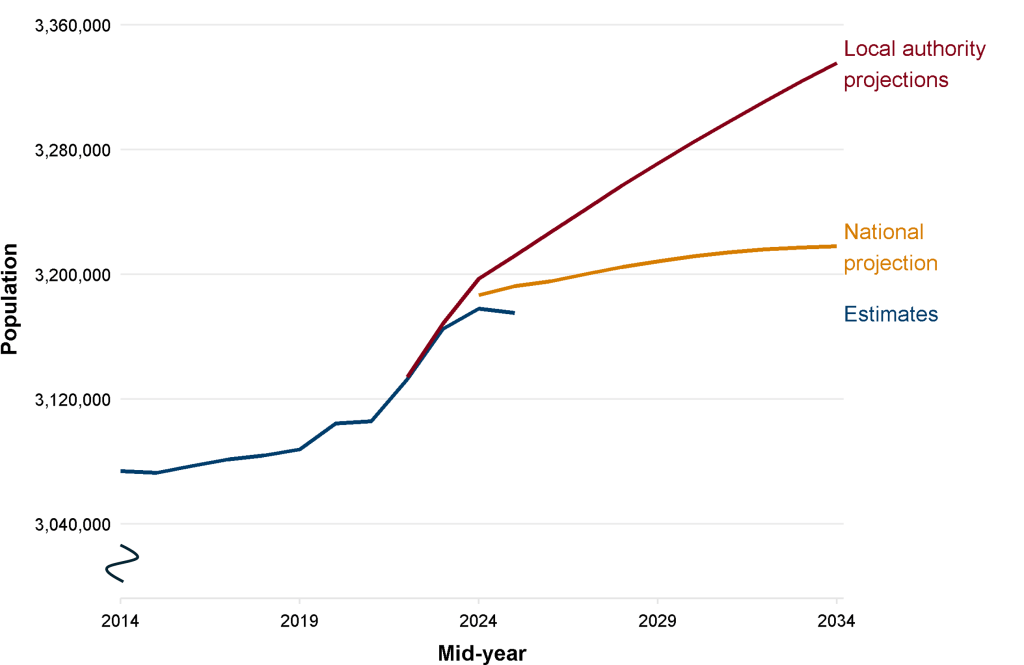
Description of figure 2: a line chart showing that the latest national population projections are lower than the local authority projections. The chart also shows how the latest population estimates are lower than the national projections.
Source: Population estimates and national population projections from the ONS. Local authority population projections from the Welsh Government.
By 2034, for example, the sum of the local authority population projections is 3.7% higher than the latest national population projections.
What we are doing next
Our local authority population projections are used to calculate household projections for local authorities. In turn, these are then used to calculate estimates of additional housing need.
To bring our local authority population projections more in line with the latest trends, we are now planning to start updating our projections from this autumn. This will include exploring whether we need to make any changes to our methods to ensure coherence with the latest estimates and projections from the ONS.
In the meantime, users should continue to consider the full range of local authority population and household projections that we publish. I spoke about this in a previous blog post when we first published our local authority projections.
We publish alternative projections, or ‘variant’ projections. These show how the results could differ if different assumptions are used, for example, about migration or population growth. Where population estimates are available, users should use those instead of projections, because estimates are based on what has actually happened.
We also continue to work on publishing equivalent population and household projections for national parks. The work to update our projections from this autumn will include producing updated projections for national parks as well as for local authorities.
If you have any questions about our projections or the latest population estimates in the meantime, please get in touch with the team at stats.popcensus@gov.wales.
Stephanie Howarth
Chief statistician

