We have previously published a Chief Statistician’s blog providing advice on the quality of statistics derived from the Labour Force Survey (LFS) and another highlighting improvements introduced to labour market estimates and the impacts these changes had on the reliability of labour market statistics in Wales.
Today, following continued interventions from the ONS to increase the quality of the LFS, we discuss how these developments have impacted labour market statistics for Wales and the approach we continue to recommend in order to provide a robust and timely picture of the Welsh labour market.
Darllenwch y dudalen hon yn Gymraeg.
Labour Force Survey challenges and improvements
Since February 2024 ONS have implemented a number of improvements to the LFS in order to increase the reliability of estimates derived from the survey. The initial improvement work included reweighting the LFS based on the latest available population estimates, returning to some face-to-face interviewing, increasing incentives for responses and boosting the sample size of the survey. Whilst these interventions resulted in some positive improvements to labour market statistics, the number of responses captured in the survey remained low by historical standards and therefore limited the quality of estimates for Wales.
In addition to the previous improvements now being fully embedded in LFS data, ONS have also increased the number of field interviewers. The combination of these improvements has continued to have a clear positive effect on the number of achieved responses to the LFS across the UK. It is still the case, however, that survey responses remain below levels seen in pre-pandemic periods.
Labour Force Survey: impacts of the interventions for Wales
The interventions made to the LFS have improved the number of responses and reliability at the Wales level, however the number of responses still remain low by historical standards. Compared to the pre-pandemic period the data still shows more variation due to sampling confidence intervals remain wider, and headline numbers and trends have continued to diverge from other official labour market data sources.
Sampling variability describes how survey results can change simply due to which people are captured in the survey in a particular period.
Wider confidence intervals indicate greater uncertainty and lower precision in estimating the true labour market measure.
Due to the increased volatility and wider confidence intervals since mid-2022, as shown in figures 1 and 2, it is difficult to state whether quarterly and annual changes in the data are an actual reflection of changes in the Welsh labour market, or solely the impact of the smaller achieved sample.
Figure 1: LFS employment rate and confidence intervals for Wales, three months to January 2019 to the three months to January 2026 [Note 1] [Note 2]
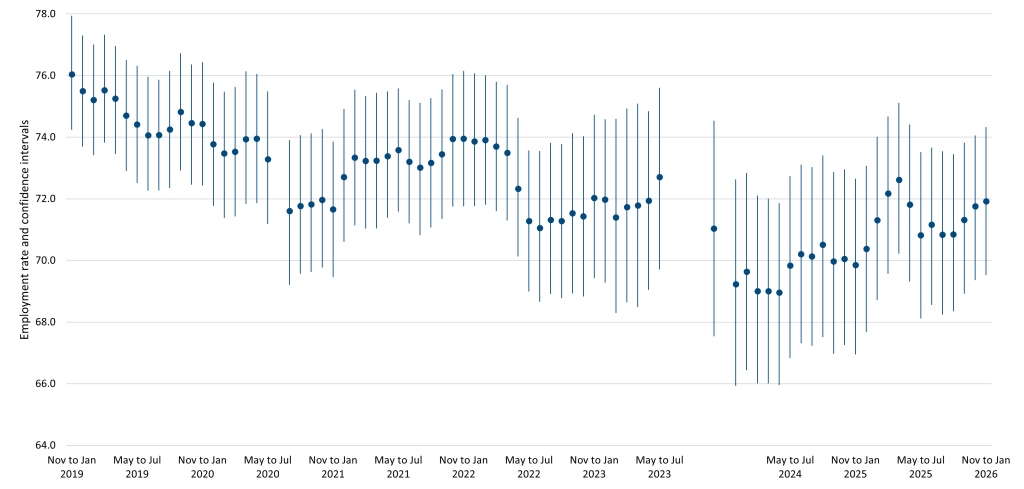
Description of figure 1: a chart showing LFS employment rates and corresponding confidence intervals for Wales. The employment rate has decreased overall since 2019 alongside increases in confidence intervals particularly from mid-2022, however the confidence intervals have narrowed slightly since the most recent interventions by ONS.
[Note 1] The missing periods in the data between June to August 2023 and November to January 2024 in figures 1 and 2 is due to ONS temporarily pausing the LFS for these periods at their original time of publication.
[Note 2] Data presented for July to September 2022 through to September to November 2023 use confidence intervals based on an older LFS weight. ONS have confirmed that there would not be a significant difference between confidence intervals based on the previous and latest weights.
Figure 2: LFS unemployment rate and confidence intervals for Wales, three months to January 2019 to the three months to January 2026 [Note 1] [Note 2]
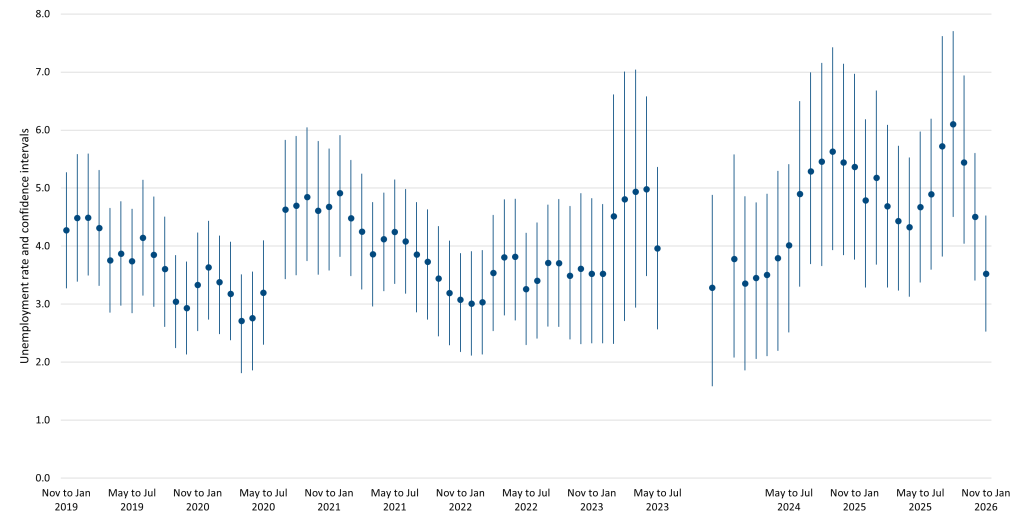
Description of figure 2: a chart showing LFS unemployment rates and corresponding confidence intervals in Wales. The volatility of the unemployment rate and the size of the corresponding confidence intervals have both increased since 2019 particularly from late 2022, however confidence intervals have narrowed slightly since the most recent interventions by ONS.
[Note 1] The missing periods in the data between June to August 2023 and November to January 2024 in figures 1 and 2 is due to ONS temporarily pausing the LFS for these periods at their original time of publication.
[Note 2] Data presented for July to September 2022 through to September to November 2023 use confidence intervals based on an older LFS weight. ONS have confirmed that there would not be a significant difference between confidence intervals based on the previous and latest weights.
The uncertainty of LFS estimates continues to be evident when comparing the LFS to other data sources. LFS employment numbers and trends for Wales have diverged from HMRC Pay As You Earn (PAYE) Real Time Information (RTI) data on employees since 2021, as shown in figure 3.
Figure 3: LFS employment rate and HMRC PAYE RTI employee trends for Wales and the UK, three months to January 2019 to the three months to January 2026 (December to February 2019 to November to January 2020 = 100)
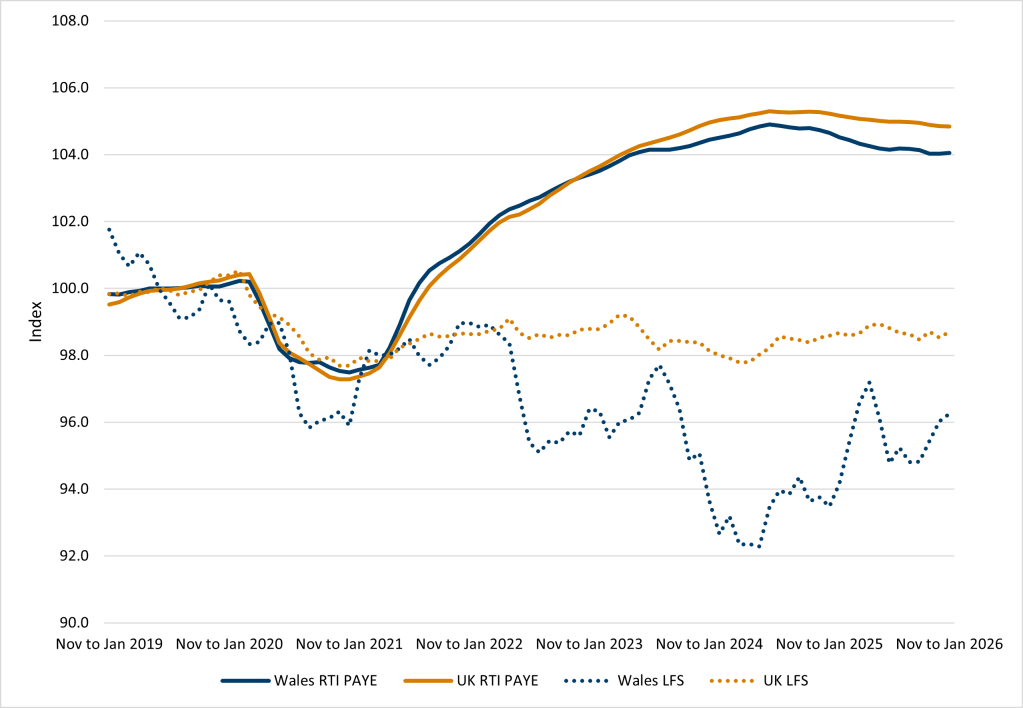
Description of figure 3: a line chart showing LFS employment rates and HMRC PAYE RTI employee numbers for Wales and the UK, indexed to the period December to February 2019 to November to January 2020. RTI PAYE employee numbers have shown similar trends between Wales and the UK since 2019, whereas the LFS employment rate for Wales has diverged from the UK rate and has shown different trends to the PAYE RTI data.
It is worth noting, the two data sources presented in figure 3 show slightly different measures of employment, with HMRC RTI data only including employees and LFS data including those who are self-employed. While changes in self-employment may explain a small part of the differing trends between the sources, the continued divergence is still cause for concern.
Although recent adjustments to the LFS have strengthened sample sizes and improved reliability, the LFS continues to show heightened variability, broader confidence intervals and weaker alignment with other sources, suggesting that, on its own, the LFS still offers an uncertain picture of Wales’ labour market when viewed in isolation.
Providing a clearer picture of the Welsh labour market
ONS are continuing to develop the Transformed Labour Force Survey (TLFS), which aims to provide more reliable and robust labour market estimates across the UK in the future. In the meantime however, whilst the interventions ONS have made to the LFS have resulted in improvements to the quality of estimates, these still remain uncertain. We continue to recommend using the LFS data alongside the trends in other measures of the labour market, particularly workforce jobs (a quarterly measure of jobs), claimant count (the number of people claiming unemployment related benefits) and the RTI data from HMRC (the number of employees on payroll) to gain a clearer picture of the Welsh labour market. Each of these series suggest that the labour market in Wales is following a similar trend to the UK as a whole.
Our Labour Market Overview bulletin will continue to draw from an array of relevant labour market data sources, providing a timely and comprehensive picture of the Welsh labour market each month.
Stephanie Howarth
Chief Statistician
 Digital and Data Blog